


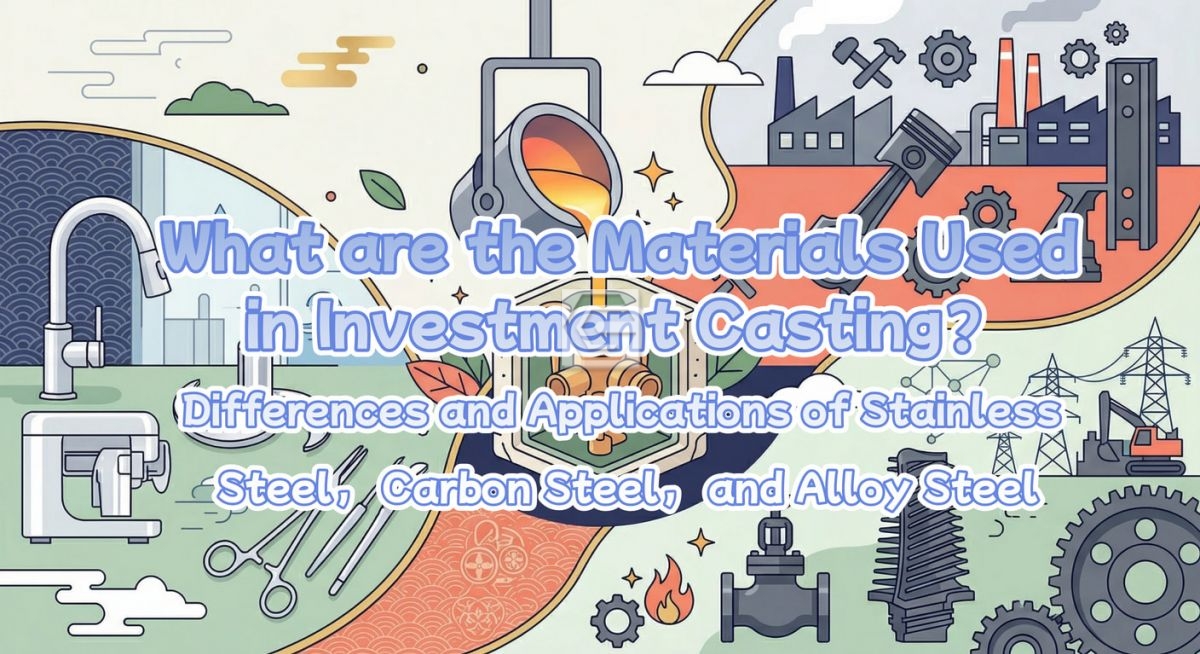
Article Summary

- What is Investment Casting? Why is Material Selection So Crucial?
- What Materials Can Be Used in Investment Casting?
- Stainless Steel Castings: The Premier Choice for Corrosion Resistance and Hygiene
- Carbon Steel Castings: Balancing High Strength and Cost-Effectiveness
- Alloy Steel Castings: The Premium Choice for Enhanced Performance
- Stainless Steel vs. Carbon Steel vs. Alloy Steel: A Quick Comparison
- C.S. Casting's Material Advantages and Manufacturing Capabilities
- How to Choose the Right Investment Casting Material?
- Choosing the Right Material Multiplies Product Value
- Frequently Asked Questions (FAQ) about Casting Materials
In the field of precision manufacturing, investment casting is widely adopted across various industries for its ability to produce high-precision, complex-shaped components. From valves and automotive parts to food processing machinery and fluid equipment, material selection often directly impacts product performance and service life.
As a professional B2B foundry, C&S Metal Products Co., Ltd. will provide an in-depth analysis of the common materials used in investment casting - stainless steel, carbon steel, and alloy steel. We will break down their differences and applications to help you make the best choices in your product design and manufacturing decisions.
What is Investment Casting? Why is Material Selection So Crucial?
Investment casting is a process that utilizes wax patterns to create precision castings, offering the following advantages:
- Capability to produce complex geometric shapes
- High dimensional accuracy (Near Net Shape)
- Reduction in post-machining costs
- Excellent surface finish
However, no matter how precise the process is, selecting the wrong material can still lead to product failure. For instance, inadequate corrosion resistance, insufficient strength, or poor machinability will all affect the final application. Therefore, understanding the characteristics of different steel materials is a critical key for B2B procurement and engineering design.
What Materials Can Be Used in Investment Casting?
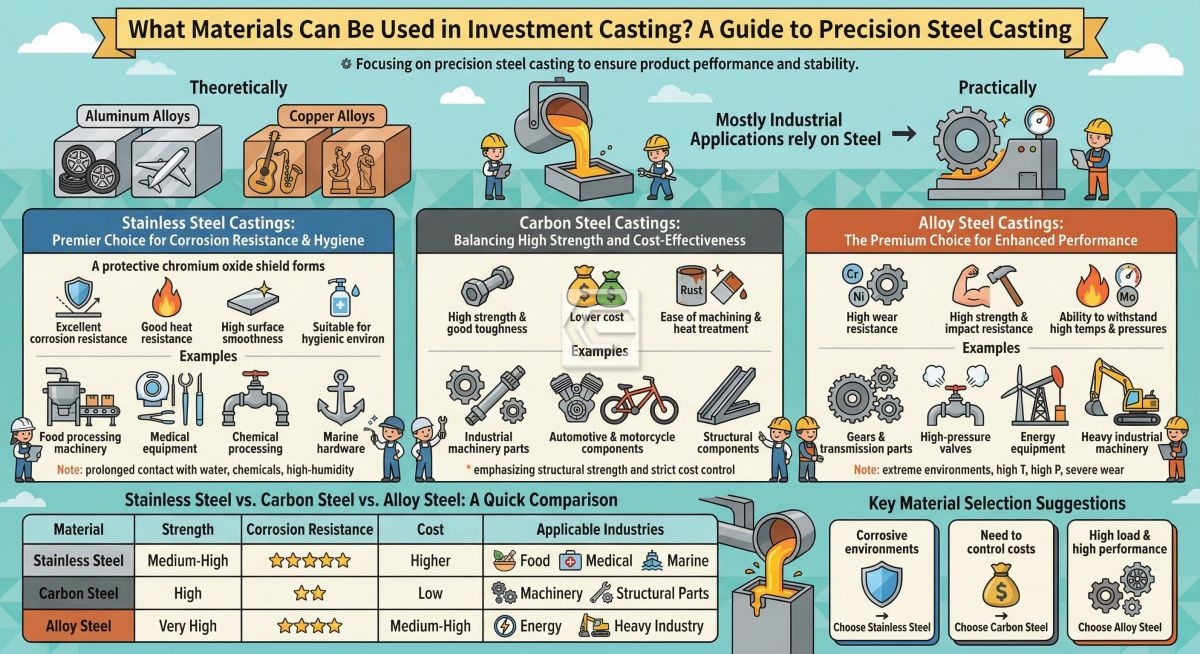
Theoretically, investment casting can be applied to a variety of metal materials, including:
- Aluminum alloys
- Copper alloys
- Steel materials (Stainless steel, Carbon steel, Alloy steel)
But in practice, most industrial applications requiring high precision and high strength still primarily rely on steel.
Taking C.S. Casting as an example, we focus on precision steel casting, which effectively ensures the mechanical performance and long-term stability of the products.
Stainless Steel Castings: The Premier Choice for Corrosion Resistance and Hygiene
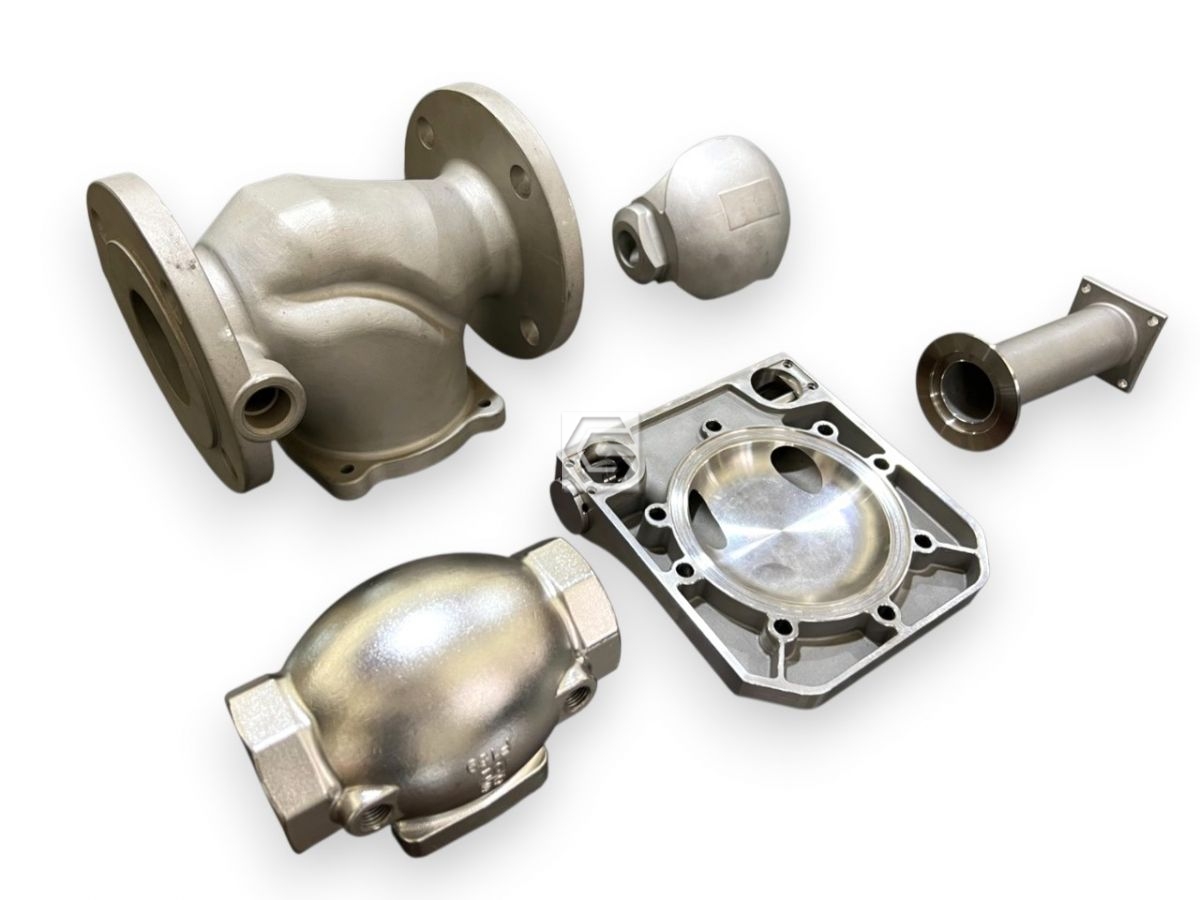
Because stainless steel contains chromium (Cr), it forms a protective oxide film, providing:
- Excellent corrosion resistance
- Good heat resistance
- High surface smoothness
- Suitability for hygienic and clean environments
Common Applications
- Food processing machinery parts
- Medical equipment
- Chemical processing equipment
- Marine hardware
Suitable Scenarios
When your product requires prolonged contact with water, chemicals, or high-humidity environments, stainless steel is the premier choice.
Carbon Steel Castings: Balancing High Strength and Cost-Effectiveness

Carbon steel is primarily composed of iron and carbon, featuring:
- High strength and good toughness
- Lower cost
- Ease of machining and heat treatment
However, its main drawback is poorer corrosion resistance, which usually requires surface treatments to improve.
Common Applications
- Industrial machinery parts
- Automotive and motorcycle components
- Structural and supporting components
Suitable Scenarios
Ideal for products emphasizing structural strength and strict cost control, such as heavy industrial equipment.
Alloy Steel Castings: The Premium Choice for Enhanced Performance
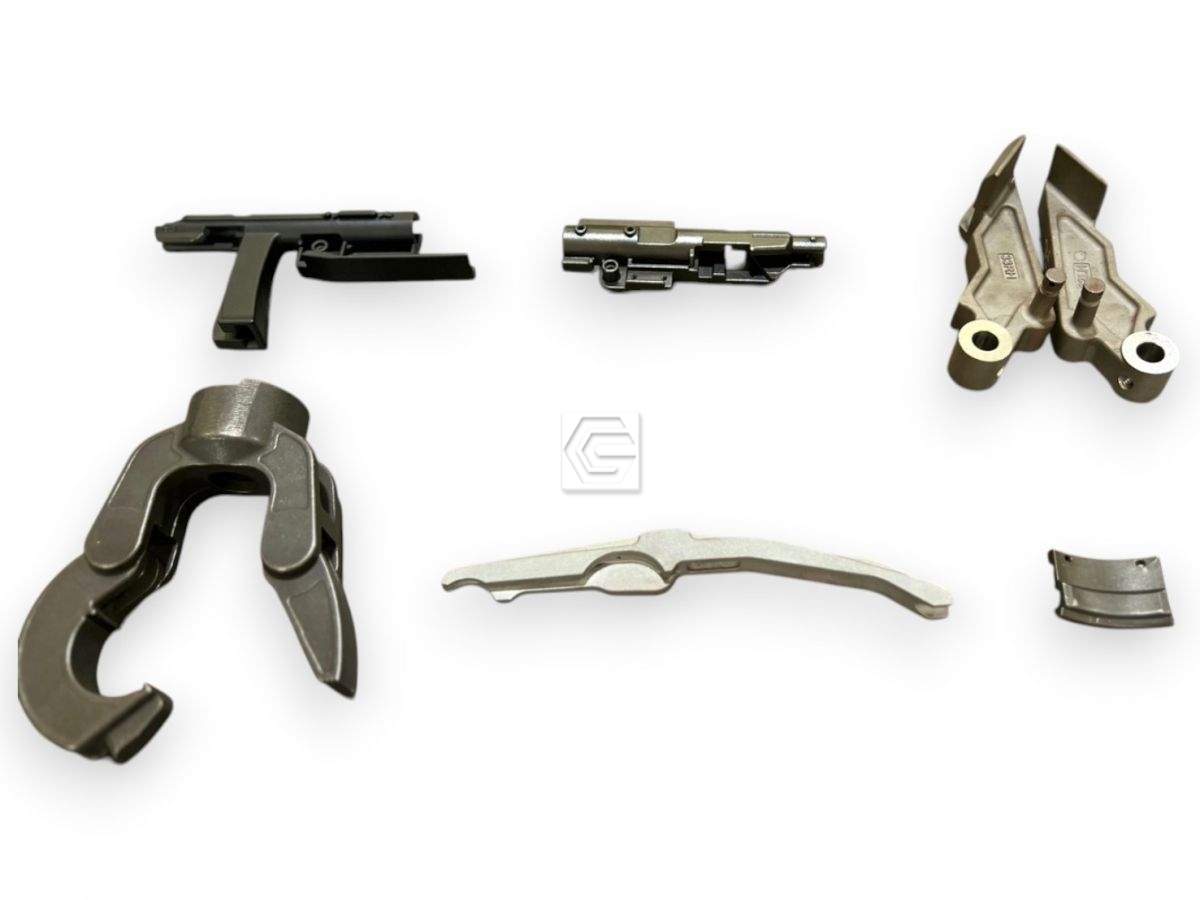
Alloy steel is created by adding elements like chromium, nickel, and molybdenum to carbon steel to elevate its performance:
- High wear resistance
- High strength and impact resistance
- Ability to withstand high temperatures and high pressures
Common Applications
- Gears and transmission parts
- High-pressure valves
- Energy equipment
- Heavy industrial machinery
Suitable Scenarios
Perfect for extreme environments, such as conditions with high temperatures, high pressures, or severe wear and tear.
Stainless Steel vs. Carbon Steel vs. Alloy Steel: A Quick Comparison
| Material | Strength | Corrosion Resistance | Cost | Applicable Industries |
|---|---|---|---|---|
| Stainless Steel | Medium-High | ★★★★★ | Higher | Food, Medical, Marine |
| Carbon Steel | High | ★★ | Low | Machinery, Structural Parts |
| Alloy Steel | Very High | ★★★★ | Medium-High | Energy, Heavy Industry |
Key Material Selection Suggestions:
- Corrosive environments → Choose Stainless Steel
- Need to control costs → Choose Carbon Steel
- High load & high performance → Choose Alloy Steel
C.S. Casting's Material Advantages and Manufacturing Capabilities
Since its establishment in 1980, C&S Metal Products Co., Ltd. has continuously deepened its technical expertise from sand casting processes to precision investment casting, successfully obtaining ISO 9001:2015 and PED 2014/68/EU certifications.
In terms of material control and quality management, C&S Metal Products Co., Ltd. is equipped with:
- Spectrometers to ensure precise material composition
- Coordinate Measuring Machines (CMM) and 2.5D measuring equipment
- Non-Destructive Testing (NDT) such as Magnetic Particle Inspection
- TrueX handheld alloy analysis technology
Furthermore, by utilizing SolidCast and FlowCast mold flow analysis, we can predict casting defects before tooling, significantly improving yield rates and product stability.
- Focus on steel casting (Stainless Steel / Carbon Steel / Alloy Steel)
- Manufacturing capabilities for high-precision, complex parts
- One-stop service combining Casting + Machining
How to Choose the Right Investment Casting Material?
In practice, we recommend evaluating your needs from the following perspectives:
- Operating Environment: Will it be exposed to corrosive media or high temperatures?
- Mechanical Requirements: What are the needs for strength, hardness, and wear resistance?
- Cost Budget: Considerations for material and machining costs.
- Production Volume: Is there a need for large-scale, stable production?
If you are unsure, we recommend partnering with an experienced foundry like us to select the optimal material solution through a professional engineering evaluation.
Choosing the Right Material Multiplies Product Value
Investment casting is not just a manufacturing process; it is a discipline of "material engineering."
Stainless steel, carbon steel, and alloy steel each have their own advantages and application scenarios. Only by choosing the right material can the maximum performance of your product be realized.
Leveraging over 40 years of casting experience and a comprehensive quality control system, C&S Metal Products Co., Ltd. provides high-precision, highly reliable steel casting solutions for various industries worldwide.
If you are looking for a stable and professional investment casting partner, C&S Metal will be your trusted choice.
Frequently Asked Questions (FAQ) about Casting Materials
Q1: Must investment casting only use steel materials?
No. Theoretically, materials like aluminum and copper can be used, but in high-strength and precision industrial applications, steel remains the mainstream choice.
Q2: Is stainless steel always better than carbon steel?
Not necessarily. Stainless steel offers excellent corrosion resistance but comes at a higher cost; carbon steel holds a greater advantage in structural strength and overall cost control.
Q3: How do I determine if alloy steel is needed?
If your product needs to withstand high temperatures, high pressures, or highly abrasive environments, choosing alloy steel is highly recommended to enhance performance and extend lifespan.
