


Summary

- What Is the Lost Wax Casting Process?
- Step 1: Wax Pattern Creation
- Step 2: Wax Assembly (Treeing)
- Step 3: Ceramic Shell Building
- Step 4: Dewaxing (Lost Wax Removal)
- Step 5: Metal Melting and Pouring
- Step 6: Shell Removal and Casting Separation
- Step 7: Heat Treatment and Finishing
- Step 8: Inspection and Quality Control
- Applications of Lost Wax Casting
- Why Choose C&S for Precision Lost Wax Casting?
- Conclusion
The lost wax casting process, also known as investment casting, is one of the most precise and versatile metal manufacturing methods used in modern industries. This technique allows manufacturers to produce complex metal components with excellent dimensional accuracy, smooth surface finishes, and minimal material waste.
At C&S Metal Products Co., Ltd., we have specialized in precision lost wax casting since 1980, supplying high-quality cast components to industries such as valve manufacturing, industrial machinery, fluid control systems, marine hardware, automotive parts, and food processing equipment. With advanced equipment, strict inspection systems, and ISO-certified quality management, we deliver reliable casting solutions for demanding industrial applications.
In this article, we explain the lost wax casting process steps, from the creation of wax patterns to the final precision metal components.
What Is the Lost Wax Casting Process?
The lost wax casting process is a manufacturing technique where a wax model is used to create a ceramic mold. Once the mold is formed, the wax is melted and removed, leaving a cavity that is filled with molten metal to produce the final casting.
Because the wax pattern is destroyed during the process, it is called lost wax casting. This method enables manufacturers to produce near-net-shape metal parts, which means less machining, less material waste, and higher production efficiency.
Compared with conventional casting methods, investment casting offers several key advantages:
- High dimensional accuracy
- Excellent surface finish
- Ability to produce complex shapes
- Reduced secondary machining
- Efficient material utilization
These advantages make the process ideal for industries that require precision components, consistent quality, and dependable performance.
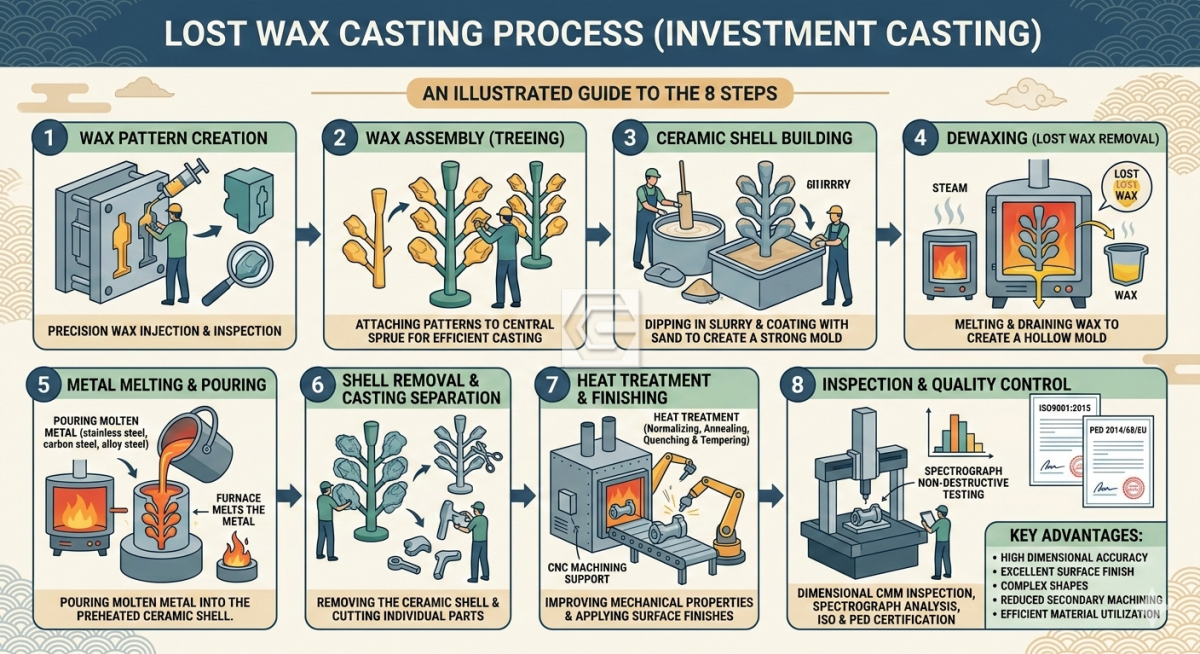
Step 1: Wax Pattern Creation
The first stage in the lost wax casting process steps is the creation of a wax pattern that matches the final shape of the metal component.
Molten wax is injected into a precision mold to form the wax pattern. After cooling and solidifying, the wax model is removed and inspected to ensure dimensional consistency.
For mass production, multiple wax patterns can be created with excellent repeatability. At C&S Metal Products, precise tooling and stable process control help ensure each pattern meets the required specifications before moving to the next stage.
Step 2: Wax Assembly
After individual wax patterns are produced, they are attached to a central wax sprue to form a wax tree.
This assembly design allows several parts to be cast in one cycle, improving productivity and supporting more consistent metal flow during pouring. Proper wax assembly is important because it affects both casting efficiency and final part quality.
Step 3: Ceramic Shell Building
The completed wax tree is then coated to create a ceramic shell mold. This step is one of the most important parts of the investment casting process.
The wax assembly is repeatedly dipped into ceramic slurry and coated with refractory sand. Each layer is dried before the next layer is applied. This process continues until a strong and heat-resistant ceramic shell is formed around the wax patterns.
The quality of the ceramic shell directly affects the dimensional accuracy, detail reproduction, and surface finish of the final casting.
Step 4: Dewaxing (Lost Wax Removal)
Once the ceramic shell has fully hardened, the wax inside must be removed. The mold is placed in a furnace where the wax melts and drains away.
This is the step that gives the process its name: lost wax casting. After the wax is removed, a hollow ceramic cavity remains, ready to receive molten metal.
At C&S, controlled heating procedures help ensure complete wax removal while preserving the strength and integrity of the ceramic shell.
Step 5: Metal Melting and Pouring
Once the mold is prepared, the selected metal material is melted and poured into the ceramic shell cavity.
Common materials used in the lost wax casting process include:
- Stainless steel
- Carbon steel
- Alloy steel
- Heat-resistant alloys
The molten metal flows into the mold and fills even complex geometries in detail. After cooling and solidification, the metal takes the shape of the original wax pattern.
This ability to reproduce complicated shapes is one of the main reasons why precision investment casting is widely used across industrial sectors.
Step 6: Shell Removal and Casting Separation
After the molten metal has cooled, the ceramic shell is removed through vibration, blasting, or mechanical methods.
Once the shell is broken away, the metal casting tree is exposed. Individual parts are then cut from the tree and separated for further processing.
At this point, the castings already closely resemble the final product shape, which helps reduce machining time and material waste.
Step 7: Heat Treatment and Finishing
Depending on the material and end-use requirements, cast parts may undergo heat treatment to improve mechanical properties such as strength, hardness, or toughness.
Typical heat treatment methods may include:
- Normalizing
- Annealing
- Quenching and tempering
Additional finishing operations such as grinding, polishing, shot blasting, and machining may also be applied to meet tighter tolerances or surface finish requirements.
C&S Metal Products also provides CNC machining support for customers who require more precise post-casting dimensions and finished part integration.
Step 8: Inspection and Quality Control
Inspection is a critical part of the lost wax casting process steps. Each casting must be checked to ensure it meets customer specifications and industry requirements.
Quality control methods may include:
- 3D Coordinate Measuring Machine (CMM) inspection
- Magnetic particle testing
- Spectrograph analysis
- Mechanical testing
- Non-destructive testing
C&S Metal Products operates under ISO9001:2015 quality management standards and also holds PED 2014/68/EU certification, helping ensure stable quality, traceability, and reliable performance for industrial applications.
Applications of Lost Wax Casting
Thanks to its precision, flexibility, and ability to produce complex shapes, the lost wax casting process is widely used in many industrial sectors.
Typical applications include:
- Valve parts
- Industrial machinery components
- Pneumatic tool parts
- Fluid control equipment
- Motor vehicle components
- Marine hardware
- Food machinery parts
- Sports equipment components
This versatility makes investment casting a highly effective solution for OEMs looking for accuracy, repeatability, and material efficiency.
Why Choose C&S for Precision Lost Wax Casting?
With decades of experience in OEM investment casting manufacturing, C&S Metal Products Co., Ltd. has built strong capabilities in producing precision metal parts for various industrial applications.
Our manufacturing strengths include:
- Established in 1980 with long-term casting expertise
- Specialized in stainless steel, carbon steel, and alloy steel casting
- In-house machining department and CNC capability
- Advanced software, including the Solid Works system, is used to simulate and analyze injection molding processes, ensuring proper gate positioning to prevent shrinkage defects during production.
- 3D measurement systems and non-destructive testing equipment
- ERP-supported production management
- ISO9001:2015 and PED 2014/68/EU certified production
At C&S, we combine engineering know-how, strict inspection, and practical manufacturing experience to provide customers with reliable precision cast components that meet demanding industrial standards.
Conclusion
The lost wax casting process is a highly efficient and precise manufacturing method for producing complex metal parts with excellent dimensional consistency and surface quality.
From wax pattern creation to final inspection, every stage of the process contributes to the performance and reliability of the finished component. For manufacturers seeking near-net-shape production, reduced material waste, and dependable part quality, investment casting remains one of the most valuable metal forming solutions available.
With more than four decades of experience, advanced equipment, and a strong commitment to quality, C&S Metal Products Co., Ltd. continues to support global customers with dependable precision lost wax casting solutions.
