


Article Summary

- What Are the Core Differences Among the Five Metal Manufacturing Processes?
- Comparison of Investment Casting, Sand Casting, Forging, Die Casting, and CNC Machining
- How Should Buyers Choose the Right Manufacturing Process?
- C&S Metal Products Provides Integrated Precision Casting and Secondary Machining Services
- Frequently Asked Questions About Metal Part Manufacturing
Selecting the wrong manufacturing process during metal part development can increase unit costs and may also lead to dimensional inconsistency, material waste, or delivery delays. Investment casting, sand casting, forging, die casting, and CNC machining each have their own suitable applications. C&S Metal Products recommends that buyers evaluate material, part geometry, precision, production volume, and secondary machining requirements as a whole to achieve the right balance between quality and total cost.
What Are the Core Differences Among the Five Metal Manufacturing Processes?
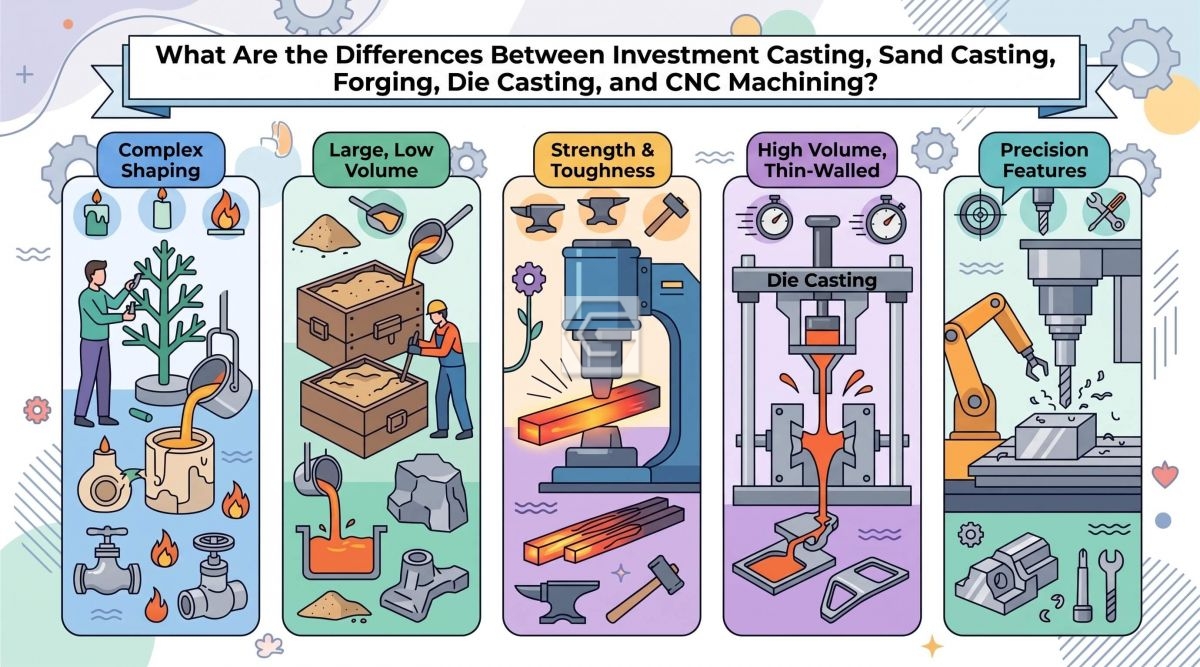
Investment casting, sand casting, and die casting form parts by introducing molten metal into a mold. Forging shapes solid metal by applying pressure, while CNC machining removes material from solid stock. These different principles affect tooling costs, production speed, material selection, part strength, and machining allowances.
1. Investment Casting: Ideal for Complex, High-Precision Metal Parts
Investment casting, also known as precision casting or lost wax casting, produces parts through wax pattern creation, ceramic shell building, dewaxing, and metal pouring. The process can create curved surfaces, internal cavities, and fine details. Its dimensional accuracy and surface finish are generally superior to those of sand casting, helping reduce machining requirements and material waste.
Investment casting is suitable for stainless steel, carbon steel, and alloy steel. It is commonly used for valves, fluid handling equipment, pneumatic tools, industrial machinery, and marine hardware. When a product has a certain production volume, complex geometry, and strict consistency requirements, investment casting can offer excellent overall cost efficiency.
2. Sand Casting: Flexible for Large Parts, Low Volumes, and Early-Stage Development
Sand casting uses sand molds to form metal parts. Its initial costs are relatively easy to control, and it can accommodate large and heavy components. The process is also suitable for low-volume prototyping and a wide range of metal materials.
However, sand-cast surfaces are generally rougher, and dimensional accuracy is usually lower than that of investment casting. More machining allowance may therefore be required. Buyers should include subsequent turning, milling, and surface treatment costs when calculating the total manufacturing cost.
3. Forging: Focused on Strength, Toughness, and Fatigue Resistance
Forging uses a hammer or press to shape solid metal. The process can improve the material structure and grain flow, making it suitable for parts that must withstand impact, heavy loads, or repeated stress.
Forged parts offer advantages in strength, toughness, and fatigue resistance. However, the process is more limited when producing complex internal cavities or highly detailed geometries. Tooling and subsequent machining costs must also be considered.
4. Die Casting: Suitable for High-Volume Production of Aluminum, Zinc, and Magnesium Alloys
Die casting injects molten metal into a metal die at high speed and under high pressure. It offers fast production cycles and can produce thin walls and complex external geometries, making it suitable for high-volume products with stable and standardized specifications.
Common die-casting materials include aluminum, zinc, and magnesium alloys. Because tooling costs are relatively high, the process may not be economical for low-volume production. Porosity, pressure-tightness, welding, and heat-treatment requirements should also be evaluated during the design stage.
5. CNC Machining: High Precision, Low-Volume Prototyping, and Critical-Dimension Machining
CNC machining can directly cut bar stock or block material according to a drawing or 3D model. It is suitable for prototypes, low-volume and high-mix production, and parts with tight tolerance requirements.
However, machining complex shapes from solid stock may increase production time and material waste. For volume production, manufacturers can combine investment casting with CNC finishing. Investment casting first creates a near-net-shape part with less material removal, while CNC machining finishes critical features such as threads, sealing surfaces, and mating bores.
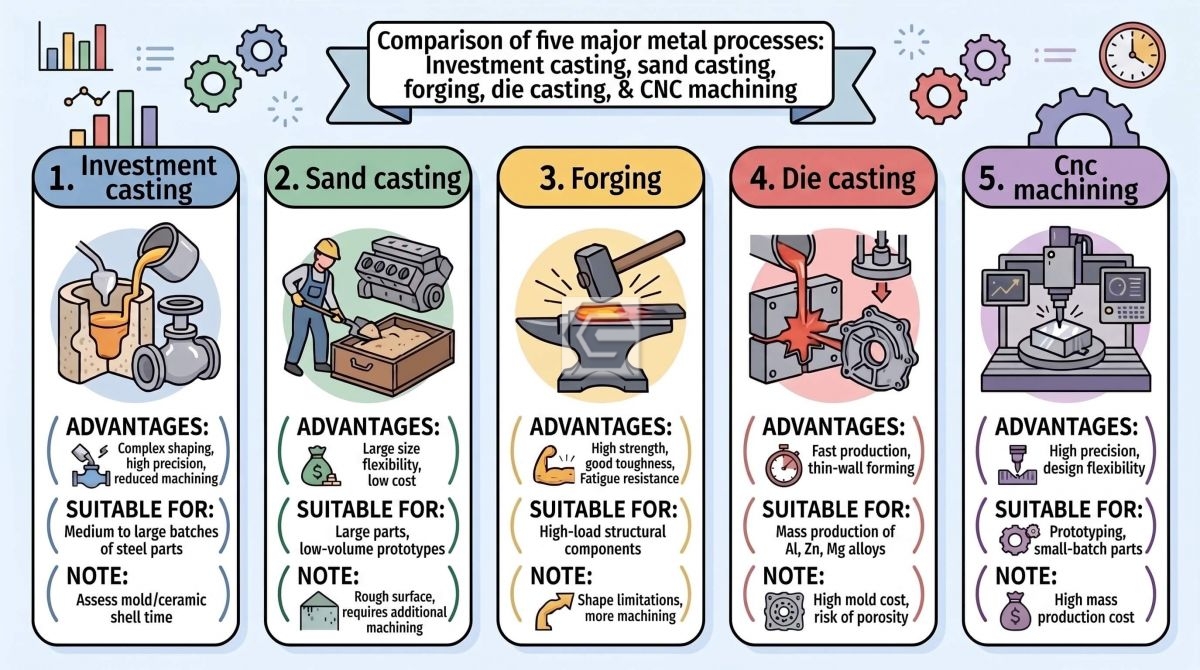
Comparison of Investment Casting, Sand Casting, Forging, Die Casting, and CNC Machining
| Process | Key Advantages | Best-Suited Applications | Purchasing Considerations |
|---|---|---|---|
| Investment Casting | Complex geometries, high accuracy, and reduced machining | Medium- to high-volume production of complex steel parts | Tooling and ceramic shell processing lead times must be evaluated |
| Sand Casting | Flexible part sizes and lower initial costs | Large parts, low-volume production, and prototypes | Additional machining may be required to meet surface finish and tolerance requirements |
| Forging | High strength, toughness, and fatigue resistance | High-load structural components | Geometry limitations and greater machining requirements must be considered |
| Die Casting | Fast production and thin-wall forming capability | High-volume production of aluminum, zinc, and magnesium alloy parts | Tooling costs and porosity risks must be evaluated |
| CNC Machining | High precision and excellent design-change flexibility | Prototypes, low-volume production, and critical tolerances | Complex parts may be costly when produced in high volumes |
How Should Buyers Choose the Right Manufacturing Process?
Before selecting a process, buyers should confirm the material and required mechanical properties, part geometry, dimensional tolerances, annual demand, and whether heat treatment, nondestructive testing, or secondary machining is required.
Precision investment casting should be considered first for complex steel parts produced in medium to high volumes when reducing machining is a priority. Sand casting is suitable for large, low-volume parts, while forging is a strong option for highly loaded components. Die casting is appropriate for high-volume, thin-wall parts made from aluminum, zinc, or magnesium alloys. CNC machining is particularly suitable for prototypes and precision features.
C&S Metal Products Provides Integrated Precision Casting and Secondary Machining Services
Founded in 1980, C&S Metal Products has extensive experience in sand casting, precision investment casting, and CNC machining. The company has also introduced SolidWorks, mold flow analysis, coordinate measuring machines, spectrometric analysis, and nondestructive testing equipment.
C&S Metal Products is certified to ISO 9001:2015 and PED 2014/68/EU. Based on customer drawings, materials, operating environments, and production quantities, the company can assist with process evaluation and provide custom castings for valves, fluid handling equipment, industrial machinery, automobiles and motorcycles, marine hardware, food-processing machinery, and other industries.
Selecting the right manufacturing process is not simply about obtaining the lowest unit price. It is about reducing material, machining, quality, and delivery risks to achieve a more reasonable total manufacturing cost.
Frequently Asked Questions About Metal Part Manufacturing
Q1: What Is the Main Difference Between Investment Casting and Sand Casting?
Investment casting generally provides better dimensional accuracy and surface finish. It is suitable for parts with complex structures, fine details, and a certain level of production volume. Sand casting offers greater advantages for large parts, low-volume prototypes, and flexible component sizes. The final decision should be based on tooling costs, machining allowances, order quantities, and quality requirements.
Q2: Can Complex Parts Be Manufactured Solely by CNC Machining?
Yes. However, machining complex shapes from solid material may increase processing time, tooling costs, and material waste. For medium- to high-volume production, manufacturers can first use investment casting to create a near-net-shape part and then use CNC machining to finish threads, sealing surfaces, and mating bores. This approach helps balance cost and critical dimensional accuracy.
Q3: How Should a Process Be Selected for Low-Volume Prototyping and High-Volume Production?
CNC machining or sand casting can be considered first for low-volume prototyping to reduce the initial tooling investment. Once complex steel parts enter medium- to high-volume production, precision investment casting can usually reduce the amount of machining required. Die casting may be considered for high-volume, thin-wall aluminum, zinc, or magnesium alloy parts with fixed specifications.
Q4: Are Forged Parts Always Stronger Than Cast Parts?
Not necessarily. Forging creates continuous grain flow and generally offers advantages for parts exposed to impact, heavy loads, and fatigue stress. However, final component performance also depends on the material grade, structural design, heat treatment, and manufacturing quality. If a part has a complex geometry or requires an internal cavity, precision casting may be the more appropriate solution.
Q5: What Information Should Be Prepared Before Requesting a Quote From a Precision Casting Manufacturer?
Buyers should provide 2D drawings or 3D models, material grades, dimensional tolerances, surface roughness requirements, order quantity, annual demand, operating environment, and any heat-treatment, CNC machining, surface-treatment, or inspection requirements. The more complete the information, the more accurately C&S Metal Products can evaluate tooling, manufacturing processes, lead times, and pricing.
